AI and Humor
A machine learning algorithm walks into a bar.
"What'll you have?" asks the bartender.
The algorithm looks around and says "I'll have what everyone else is having."
Caveat 1
These slides are about verbal jokes, like
The Word Play HotelBut word play is only a small fraction of humor.
Caveat 2
AI systems generate texts that have the form of a joke.
There is surprisingly little AI modeling of what makes something funny.
Humor is Heisenbergian.
The more you observe it, the less it seems funny.
Approaches
-
Most generators based on specific joke patterns:
- Knock-knock jokes
- What do you get if you cross an X with a Y?
- What do you call an X with a Y, or X that does Y?
- Generators used to be hand-built. Only a few were built, and those rarely maintained.
- Now there are many generators online, all based on LLMs.
Gracie Allen Jokes
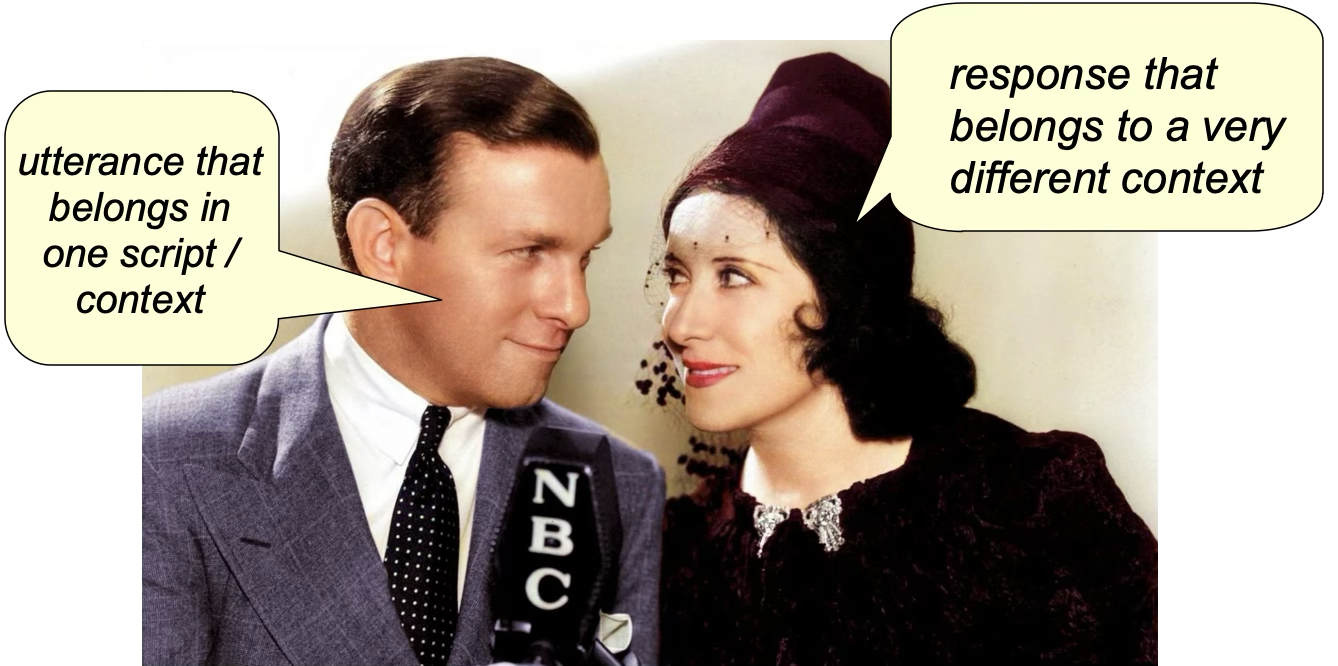
Gracie Allen Joke Pattern
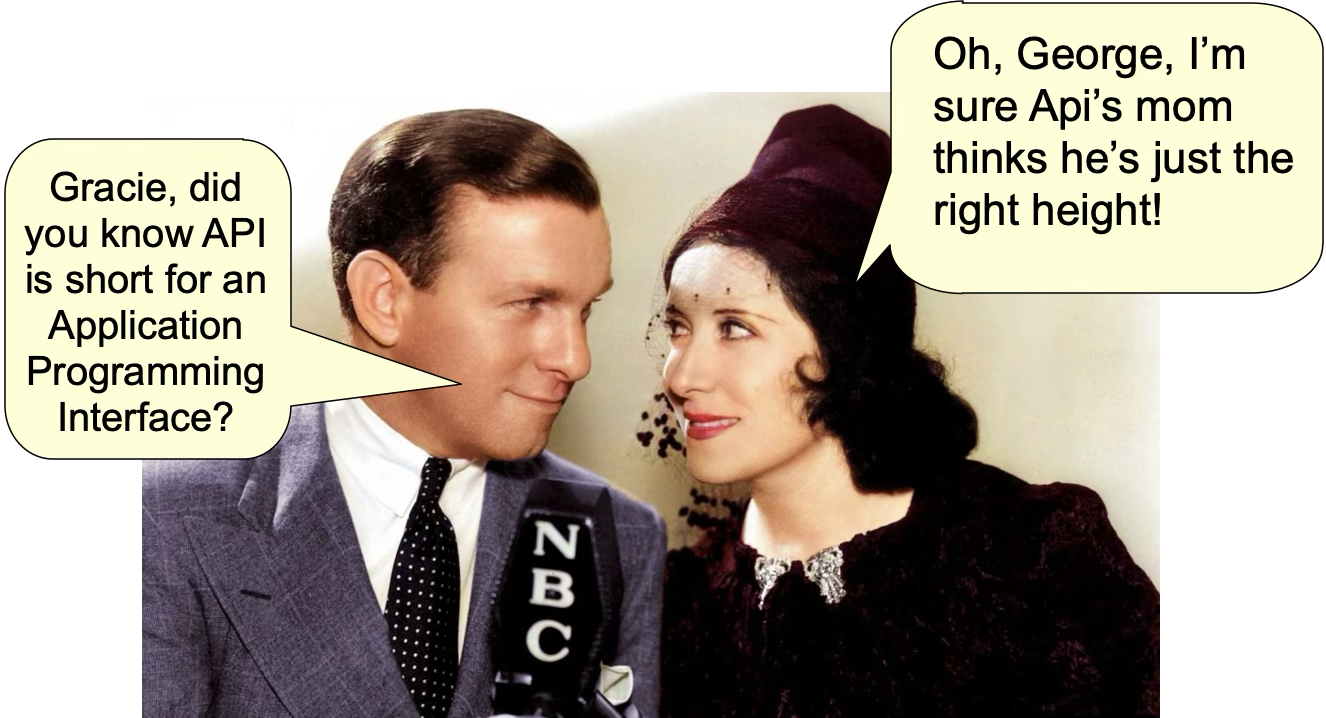
Gracie Allen Joke Example
Joke Generators
- Easy-Peasy AI Joke Generator - ChatGPT-based
- Tipli AI Joke Generator - ChatGPT-based
- AIFreeBox AI Joke Generator - ChatGPT-based
- AIFreeBox AI Pun Generator - ChatGPT-based
- Microapp AI Joke Generator - ChatGPT-based
- AI Joke Generation demo -- formerly a neural network trained on Conan O'Brien talk show jokes that was pretty bad; now ChatGPT-based
- How to Write Original Jokes (Or Have A Computer Do It For You) - a rule-based generator in Lisp; interesting but really awful code
- Pun Generator -- very hit and miss; e.g., misses obvious puns for "violins"
Pun-Driven Jokes
- Don't with an opening line or situation.
- Start with the last line, usually a play on words.
- Generate a story where that final line makes sense.
- Example: Generate a story that ends with "cheetahs never prosper"
Pun-driven Joke 1
I had a job one winter for the National Park Service, tracking down and bringing back wolves who had left Yellowstone Park.
I had tranquilized a large grey wolf and was dragging it on a sled through some sticky wet snow. I saw a frozen pond that would make part of the journey a lot easier. But as I headed toward it, a rancher came out of a small cabin and pointed a shotgun at me.
"Oh, no, you don't," he said. "You are not going to pull the wolf over my ice!"
Pun-driven Joke 2
Why can't J. K. Rowling catch mice when she's high?
A Rowling stoned gathers no mouse.
LLMs and Pun-driven Jokes
-
Informal experiments with "Tell a story / riddle" that
ends with some pun:
- The stories connect very weakly to the puns.
- The stories invent things rather than using existing real world facts.
-
Questions:
- Is this just bad prompting or something deeper?
- Would the difference show up in blind judgments by human readers?
- Could LMs be trained to do this in the reinforcement learning phase?